
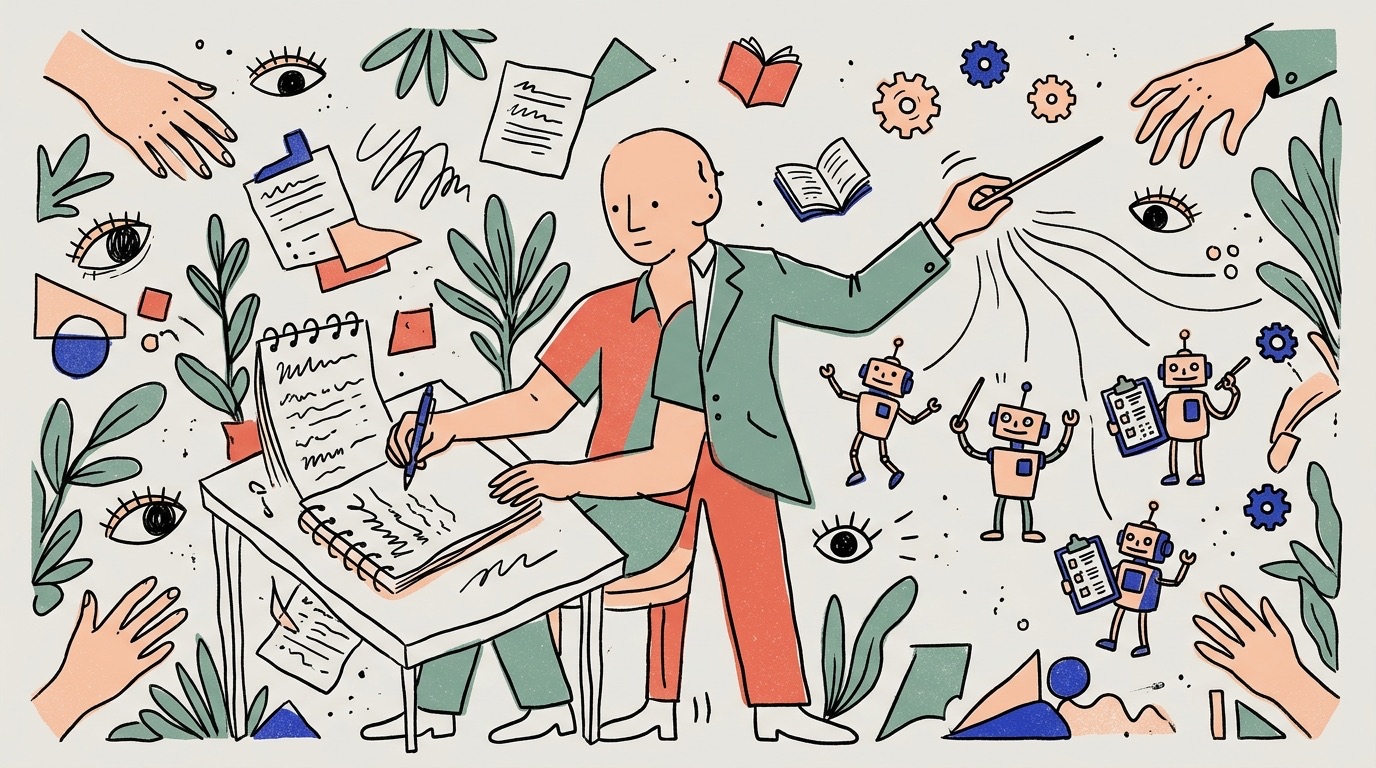

The Skill Gap Nobody's Talking About
Everyone's focused on the wrong AI skill. The training industry is obsessed with prompting — how to write better instructions, how to phrase requests, how to coax better output from a language model. Prompting is table stakes. It's the equivalent of teaching someone to type and calling it computer training.
The real skill gap is management.
Your team now has access to AI tools that can research, write, analyze, build, and automate. But nobody taught them how to manage these tools. How to delegate effectively. How to evaluate output. How to decide what to automate versus what to keep human. How to switch context between managing people and managing AI agents without losing the thread on either.
These are management skills applied to a new kind of direct report. And most organizations have exactly zero training for it.
80% of the Value Is Extraction
Here's a number that should change how you think about AI: 80-90% of the value AI delivers in a business context comes from extracting structured information from unstructured data.
Meetings. Emails. Documents. Slack threads. Support tickets. Sales calls. Your organization produces enormous volumes of information every day, and most of it sits in formats that are hard to search, hard to synthesize, and hard to act on.
The first thing I do with any team I train: make AI note-taking mandatory for every meeting. Not optional. Not "if you remember." Every meeting gets AI notes with structured extraction — action items, decisions, owners, deadlines, pulled out automatically and routed to where they need to go.
This single change — which takes about 15 minutes to set up — typically saves teams 5-10 hours per week. Not because the meetings get shorter. Because the follow-up gets eliminated. The "can you send me what we agreed on?" emails disappear. The dropped balls from meetings without notes stop happening.
That's the low-hanging fruit. The real power comes when you connect these systems.
Map Everything. Automate Anything You Do Twice.
I have a rule I teach every team: if your team does something more than twice, it should be automated. Not might be. Should be.
The process starts with mapping. Every team member documents their weekly workflows — not the high-level stuff, the granular steps. "I open Salesforce. I pull last week's pipeline changes. I format them into a table. I write a summary. I paste it into Slack." That's five steps, four of which are mechanical. Automate them.
MCP connectors make this real. Claude can connect directly to Slack, Notion, Google Workspace, CRMs, project management tools. You're not copying and pasting between windows anymore. You're building workflows where information moves from system to system with Claude handling the transformation layer in between.
One team I trained mapped 47 repetitive workflows in their first week. By the end of the month, they'd automated 31 of them. The other 16 required human judgment at key decision points — so we built semi-automated workflows where Claude does the prep and a human makes the call. Zero workflows stayed fully manual if they happened more than twice.
The Agent Management Framework
When I train teams on AI agent management, I use a framework borrowed from actual management training — because that's what this is.
Context switching. Your team already manages people and projects. Now they're also managing AI agents. The skill is knowing when to switch — when to delegate to AI, when to take over, when to review. This is a rhythm, not a rulebook. It develops with practice.
Output evaluation. AI output is not automatically good just because it's fast. Your team needs frameworks for evaluating quality — not just "does this look right?" but systematic evaluation. What's the source quality? Does this match our standards? Where might the model have hallucinated or oversimplified? Evaluation is a trainable skill.
Systematic delegation. The biggest mistake people make with AI agents: they delegate tasks instead of workflows. "Write me an email" is a task. "Monitor our support inbox, categorize issues by severity, draft responses for Level 1 tickets, and escalate Level 2+ with a summary" is a workflow. The second one compounds. The first one doesn't.
Feedback loops. Good managers give feedback. The same applies to AI agents. When output isn't right, don't just fix it manually — update the system prompt, adjust the context, add examples. Train the agent the same way you'd train a direct report. Every correction makes the next output better.
The Four Archetypes
When I look at how people actually use AI in organizations, four patterns emerge:
The Analyst. Uses AI to synthesize information, spot patterns, prepare briefings. This person turns messy data into clear decisions. Every leadership team needs at least one person operating at this level.
The Creator. Uses AI to produce content, design concepts, draft communications. This is where most creative training focuses — but it's only one of four modes.
The Engineer. Uses AI to build tools, automate systems, create internal infrastructure. You don't need to be a software engineer. You need to think systematically about how information flows through your organization.
The Operator. Uses AI to manage workflows, coordinate processes, maintain systems. This is the person who keeps the AI infrastructure running after the training ends.
Most people default to one archetype. The goal of good training is to develop fluency across all four — or at least enough awareness to know when to shift modes.
The Shift
Your team went from using AI as a search engine to using it as a note-taker. That was the first shift. The next shift — from note-taker to agent manager — is bigger, harder, and worth 10x more.
It requires new skills. Not prompting skills. Management skills. The organizations that develop these skills first won't just be more efficient. They'll be operating in a fundamentally different way than their competitors.
That gap is already opening. It's going to get wider.