
The Wrong Debate
The AI conversation in most organizations goes like this: "Will AI replace our junior people?" That's the wrong question. Not because it's unimportant — it is — but because there's a bigger, more immediate opportunity sitting one or two levels up in your org chart.
Middle managers.
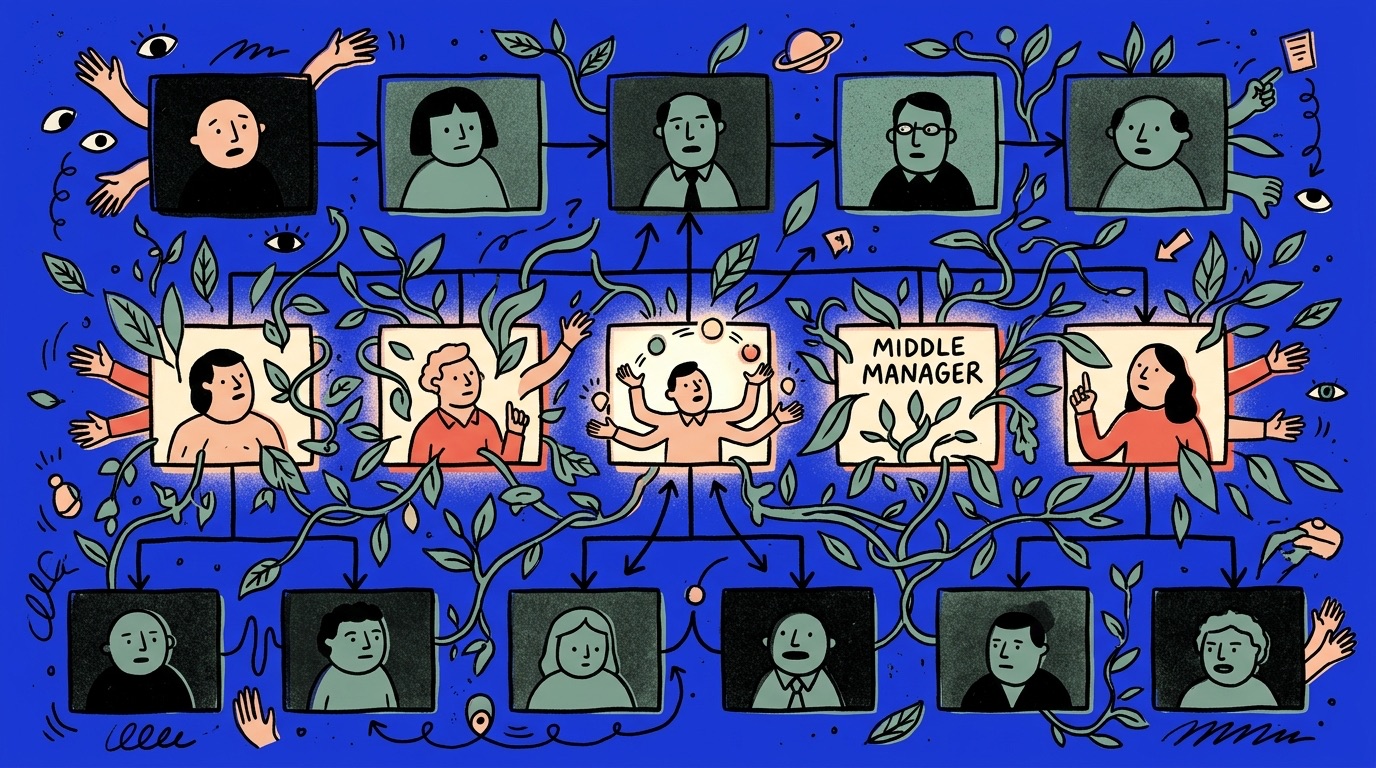
Here's what the data shows: 40% of manager time goes to administrative problem-solving. Scheduling, reporting, status updates, resource allocation, approval workflows. Only 13% goes to developing people. If you wanted to design a role for AI to transform, you'd design something that looks exactly like middle management.
Yet almost nobody is training their managers on AI. The workshops go to the junior designers. The tool licenses go to the content creators. Meanwhile, the people drowning in admin — the ones with the most to gain — are left figuring it out on their own.
What 40% Looks Like
Let me make 40% concrete. A creative director who manages a team of eight spends roughly two days a week on operational overhead. Monday morning they're building the status report. Monday afternoon they're reconciling timesheets against budgets. Tuesday they're in three meetings that could have been async updates. Wednesday they're doing the work they should have started Monday.
AI can eat almost all of that. Status reports pulled automatically from project management tools. Budget reconciliation that runs as a background workflow. Meeting prep that synthesizes last week's progress and flags decisions needed — before the meeting happens.
Two days a week. That's what's on the table. Not for junior roles. For the people who are supposed to be leading.
The Mentorship Dividend
When you free up 40% of a manager's time, the question is what fills it. If you read the previous piece on the reabsorption trap, you know the default answer: more administrative work from somewhere else. Don't let that happen.
The highest-value use of recovered manager time is people development. Mentorship. Career growth conversations. Creative direction. The stuff that made them good enough to promote in the first place.
I've watched this play out in training engagements. A creative director automates their weekly reporting pipeline in week two of the program. By week four, they're doing bi-weekly one-on-ones with every direct report — something they'd been meaning to do for two years. The team's output quality jumps within a month. Not because of AI. Because their manager finally has time to actually manage.
Multiply that across every middle manager in an organization, and you're looking at a fundamental shift in how teams operate. Not from a new AI product. From giving the existing leadership layer back the time to lead.
Redesigning the Role, Not Replacing It
There's a version of this story that ends with "so we eliminated middle management." I don't buy it. The prediction that AI will flatten org charts assumes management is purely administrative — that it's just the overhead of coordinating humans. Anyone who's actually managed a team knows that's less than half the job.
The other half — setting direction, making judgment calls under uncertainty, navigating politics, developing talent, maintaining culture — is deeply human work. AI can't do it. AI can't read the room in a client meeting. AI can't sense that a team member is disengaged before they resign. AI can't make the call to kill a project that looks good on paper but feels wrong.
What AI can do is eliminate the 40% of management that is just coordination overhead. The result isn't fewer managers. It's better managers. Managers who spend their time on the work that actually requires experience, judgment, and empathy.
The organizations that figure this out — that retrain their middle management layer for an AI-augmented role rather than trying to eliminate it — will have a structural advantage that's very hard to replicate.
Why Training Targets the Wrong People
Most AI training programs target individual contributors. Makes sense on the surface — they're the ones producing the work. But the ripple effects of training a manager are 5-10x larger than training an IC, because the manager's workflows affect everyone who reports to them.
When a designer learns to automate their mood board process, one person gets faster. When a creative director learns to automate project intake, resource allocation, and status reporting — their entire team gets faster. And more importantly, the team gets more of their manager's actual attention.
In our programs, we've started explicitly including middle management in the training cohort, with workflows designed for their specific pain points. The resistance is always the same: "I don't have time for training." The irony is painful. The person who would benefit most from AI — because they have the most administrative overhead — is the one who can't make time to learn it. Because of the administrative overhead.
We solve this by starting small. One workflow. The weekly report, or the meeting prep, or the timesheet reconciliation. Automate one thing that takes 3 hours a week. Suddenly they have 3 hours. Use one of those hours for the training that automates the next thing. It compounds from there.
The Org Chart of 2028
Gartner projects 32 million roles will need redesign annually starting in 2028. That's not replacement — that's redesign. The roles don't disappear. The job descriptions change.
The middle manager of 2028 has AI handling their operational coordination, their reporting, their scheduling, their resource allocation. Their job becomes what it should have been all along: developing people, making strategic decisions, maintaining quality, and driving creative direction.
That manager is better at their job, more fulfilled in their role, and more valuable to the organization than the version of themselves who spent Monday and Tuesday on spreadsheets.
The only question is whether your organization trains them for that future or lets them figure it out after everyone else already has.