The Tool Graveyard
Every team I audit has the same problem: too many tools, not enough workflows.
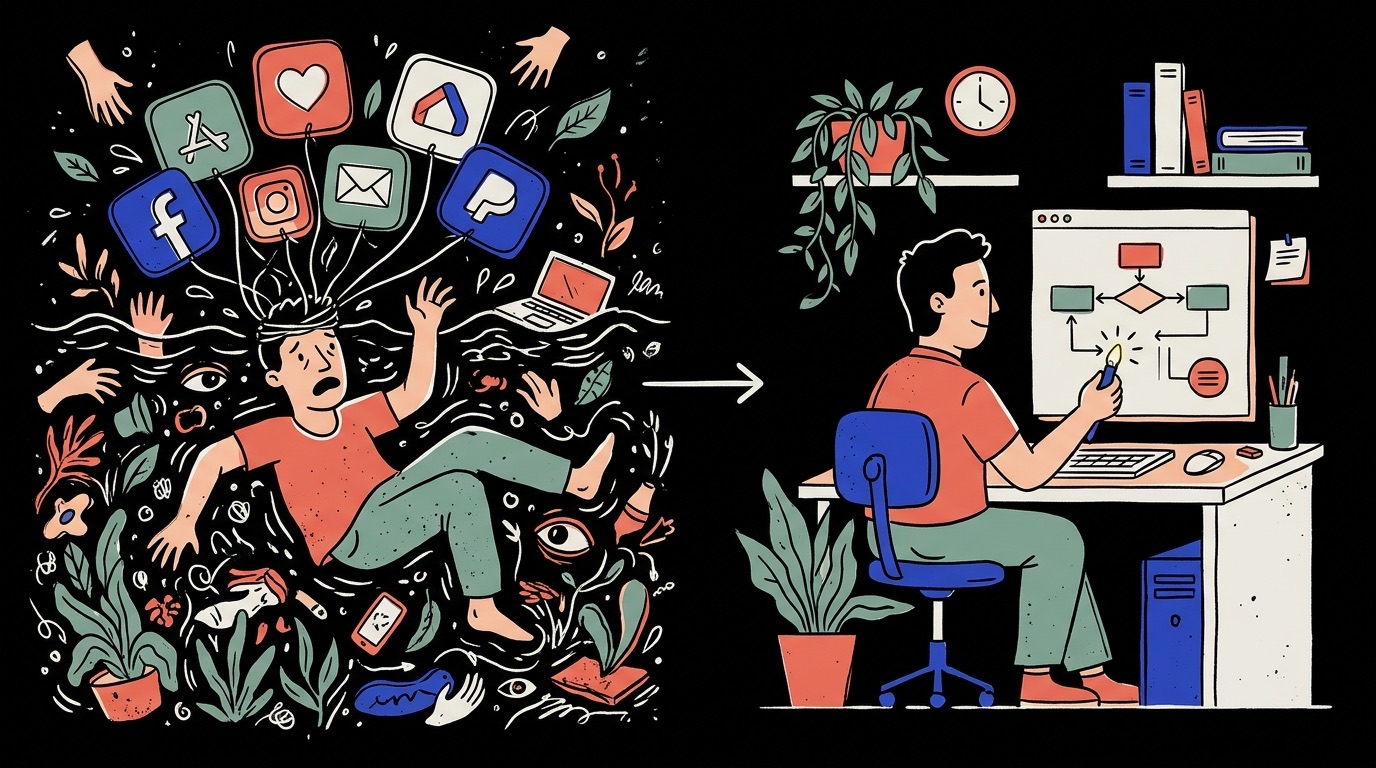
They've got a ChatGPT subscription for copy. A Midjourney account for images. A Jasper license someone bought last year. A Claude Pro seat that one person uses. Maybe a Notion AI add-on and a Copilot license from the Microsoft bundle. Total spend: somewhere between $500 and $5,000 per month. Total systematic workflows built on any of them: close to zero.
This is the tool-chasing era, and it needs to end. Not because the tools are bad — they're good. But because accumulating tools without building workflows is the organizational equivalent of buying gym equipment and stacking it in the garage. The equipment isn't the bottleneck. The routine is.
Why Teams Chase Tools
Tool-chasing feels productive. A new AI tool launches. Someone on the team tries it. It does one thing really well. They share it in Slack with a fire emoji. Leadership approves the subscription. Everyone feels like they're "adopting AI."
Except six months later, the tool is used by one person for one task, and the rest of the team forgot they had access. The research shows that no single AI application area reaches 50% adoption in most organizations. Teams have tools for everything and workflows for nothing.
The underlying problem: it's more exciting to discover a new tool than to build a repeatable workflow on an existing one. Discovery is a dopamine hit. Workflow building is boring, methodical work. But boring, methodical work is what produces actual results.
The One-Platform Thesis
Here's what I tell every team I train: pick one platform and go deep. For most teams, that's Claude. Not because Claude is objectively the best at everything — no platform is — but because depth on one platform beats surface-level access to six.
When your team goes deep on one platform, several things happen:
System prompts compound. Every system prompt your team builds becomes organizational infrastructure. A well-crafted system prompt for creative briefs doesn't just help one person — it becomes the team's standard for brief quality. After six months of building system prompts, you have a library that encodes your methodology, your standards, and your institutional knowledge. You can't build that library if the team is scattered across six tools.
Projects create persistent context. Claude's project feature lets you build persistent knowledge bases for each client, each workflow, each team function. These projects accumulate context over time — brand guidelines, previous work, style preferences — and produce better output the longer you use them. Switching tools resets that context to zero.
Workflows become transferable. When the whole team is on one platform, workflows transfer easily. Someone builds a research synthesis workflow? Everyone can use it. Someone configures a perfect brief-writing project? It becomes a team template. On six different tools, those workflows stay siloed with whoever built them.
Evaluation becomes possible. You can only build systematic evaluation if you have systematic processes. If every person uses a different tool for the same task, there's no baseline to evaluate against. Standardization sounds boring. It's the prerequisite for quality control.
What "Going Deep" Actually Means
Going deep on one platform doesn't mean using the chat window for everything. It means using the full capability stack:
System prompts for every recurring task. Not ad-hoc instructions — documented, tested, shared system prompts that encode your standards and methodology.
Projects for every client and every workflow. Persistent context that gets richer over time instead of starting from scratch with every conversation.
Styles for consistent voice and tone. Instead of describing your brand voice every time, encode it once and apply it everywhere.
MCP connectors for tool integration. Claude plugged into your project management tool, your communication platform, your file storage. The fewer windows your team has to switch between, the higher the adoption rate.
Evaluation routines that measure quality against defined criteria. Not vibes. Criteria.
Most teams use about 10% of their AI platform's capabilities. Going deep means using 70-80%. That depth creates more value than any combination of surface-level tool adoption.
The Tool Audit
If your team has more than two AI subscriptions, do an audit:
- List every AI tool your team pays for.
- For each tool, count how many people use it weekly.
- For each tool, count how many documented workflows it powers.
- For each tool, estimate the monthly value it produces (in hours saved or output generated).
Most teams discover that one or two tools do all the actual work and the rest are expensive experiments. Kill the experiments. Take that budget and invest it in training your team to go deep on the tools that matter.
When You Do Need Multiple Tools
I'm not saying one tool handles everything. Image generation might require a different platform. Code generation might live in a specialized environment. Video is its own ecosystem.
The principle isn't "only use one tool." The principle is: don't add a tool until you've maxed out the one you have. Most teams add tools to solve problems that better workflows would fix. "We need a better tool for research" often means "we need a better system prompt for research." The tool isn't the bottleneck. The workflow is.
Fewer tools. Better workflows. That's the formula.