
Experiments Don't Ship
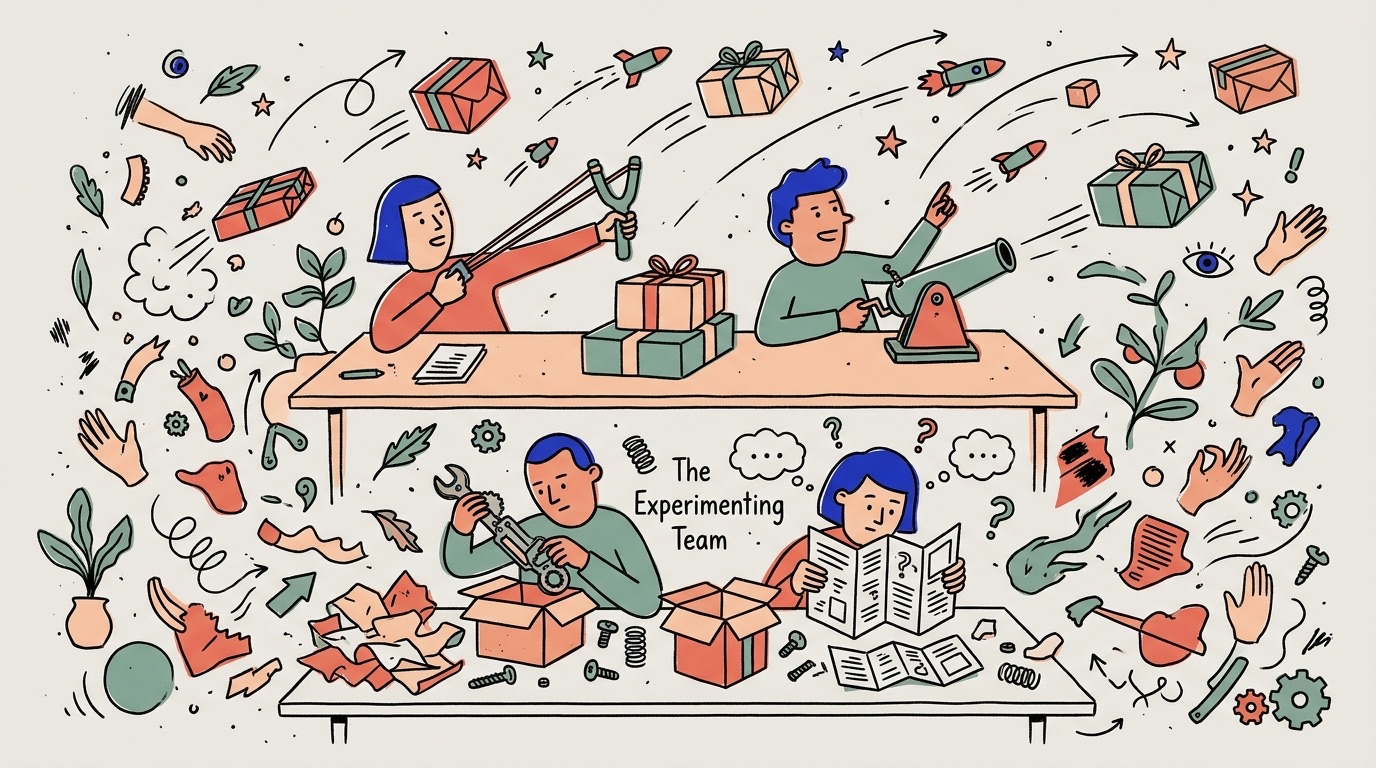
Every team I talk to has experimented with AI. They've tried the tools. They've done the workshop. Someone on the team has a ChatGPT Plus subscription and uses it for brainstorms sometimes. That's not adoption. That's tourism.
The teams that actually ship with AI — that produce real work, at real scale, for real clients using AI workflows — look fundamentally different from the teams that are still "exploring." After working with dozens of organizations across creative, operations, and strategy functions, the patterns are clear. Here's what separates the shippers from the experimenters.
1. They Automate Around Creativity, Not Instead of It
The most common mistake I see: teams trying to automate the creative process itself. "Use AI to generate the campaign concept." That's backwards. The concept is the part that requires human taste, cultural awareness, and strategic judgment.
The teams that ship use AI to automate everything around the creative work. Research synthesis. Competitive analysis. Brief preparation. Asset formatting. Versioning. Reporting. These are the hours that eat into creative thinking time — and they're the hours AI handles best.
One agency I studied built what they call "The Brief Interrogator" — a Claude project that takes a client brief, cross-references it against the brand's previous campaigns and guidelines, and produces a strategic analysis with questions the creative team should ask before starting. The creative work still comes from humans. But those humans start from a dramatically better position than they did before.
2. They Build Brand Brains
The smartest teams I've seen created persistent AI knowledge bases — essentially encoding everything the team knows about their clients into Claude projects. Brand guidelines, tone of voice, campaign history, audience research, competitive positioning. All of it, structured and searchable.
One team replaced their static brand book with a living brand system. Instead of a 200-page PDF nobody reads, the team queries the brand brain: "Would this headline fit the brand's voice?" or "What's our position on sustainability messaging?" The AI responds based on the actual brand documentation, not generic knowledge.
The result: junior team members produce brand-consistent work faster, senior team members spend less time reviewing for brand alignment, and the institutional knowledge that used to live in one person's head becomes available to everyone.
3. They Stress-Test Work With AI Personas
Here's one that surprised me. Several high-performing teams use AI personas to simulate stakeholder reactions before presenting creative work. They build Claude profiles representing their client's CMO, their target audience segments, even their internal skeptics — and run the creative through these synthetic reviewers.
One team tested concepts against AI personas and caught a strategic misalignment that would have been flagged in the client presentation. Saved them two weeks of revision. Another team reported that their synthetic audience personas identified a positioning opportunity that the human team had overlooked entirely.
This isn't replacing human judgment. It's adding a layer of pressure-testing that most teams can't afford in terms of time or budget.
4. They Killed the Copy-Paste Workflow
Teams that ship have moved past the copy-paste era. They're not generating text in one window and pasting it into another. They've connected their AI workflows to their actual tools.
MCP connectors matter here. Claude pulling data directly from Slack, pushing briefs into project management tools, synthesizing information from Google Workspace — these connections eliminate the friction that kills adoption. Every copy-paste step is a place where people revert to their old workflow.
The teams that stick with AI are the ones where using AI is less effort than not using it. That only happens when the AI is integrated into the existing toolchain, not bolted on as a separate step.
5. They Made AI Part of Onboarding
Some of the most mature AI teams built AI workflows into their onboarding process. New hires don't learn the old way first and then learn the AI way later — they start with AI-augmented workflows from day one.
This means the team's institutional knowledge transfers faster (because it's encoded in AI systems), new hires produce brand-consistent work sooner (because the brand brain catches alignment issues), and the AI adoption question disappears entirely (because there was never a non-AI workflow to revert to).
6. They Gamified Internal Adoption
A pattern I've seen work surprisingly well: teams that create lightweight internal competitions around AI usage. Not leaderboards — nobody wants that. More like a shared channel where people post their best AI workflow discoveries.
The value isn't the competition. It's the visibility. When half of AI activity happens informally and in private, the team's collective capability stays flat. When someone discovers a prompt pattern that cuts their research time in half and shares it, the whole team levels up.
The best teams I've trained create a "workflow of the week" ritual where someone demos a new AI technique. Takes 15 minutes. Produces more capability transfer than most training sessions.
7. They Have a POC Before They Have a Strategy
The teams that overplan never ship. The teams that ship started with a proof of concept — one workflow, one team, one use case — and expanded from there. They didn't write a 30-page AI strategy document. They automated one painful process, measured the results, and used those results to fund the next one.
Successful AI adoption is bottom-up momentum with top-down support. It's not a strategy deck. It's a demonstrated result that makes the next investment obvious.
8. They Measure in Workflows, Not Vibes
The teams that ship can tell you exactly how many workflows they've automated, how many hours those automations save per week, and what the error rate is. The teams that are still experimenting say things like "we're seeing good results" and "people seem to find it useful."
If you can't quantify the impact, you can't scale it. Measurement is what turns an experiment into an operation.
The Common Thread
None of these eight patterns are about which AI tool the team uses. They're about how the team works. The technology is the easy part. The organizational change — the workflows, the knowledge management, the cultural shifts — that's where results live.