
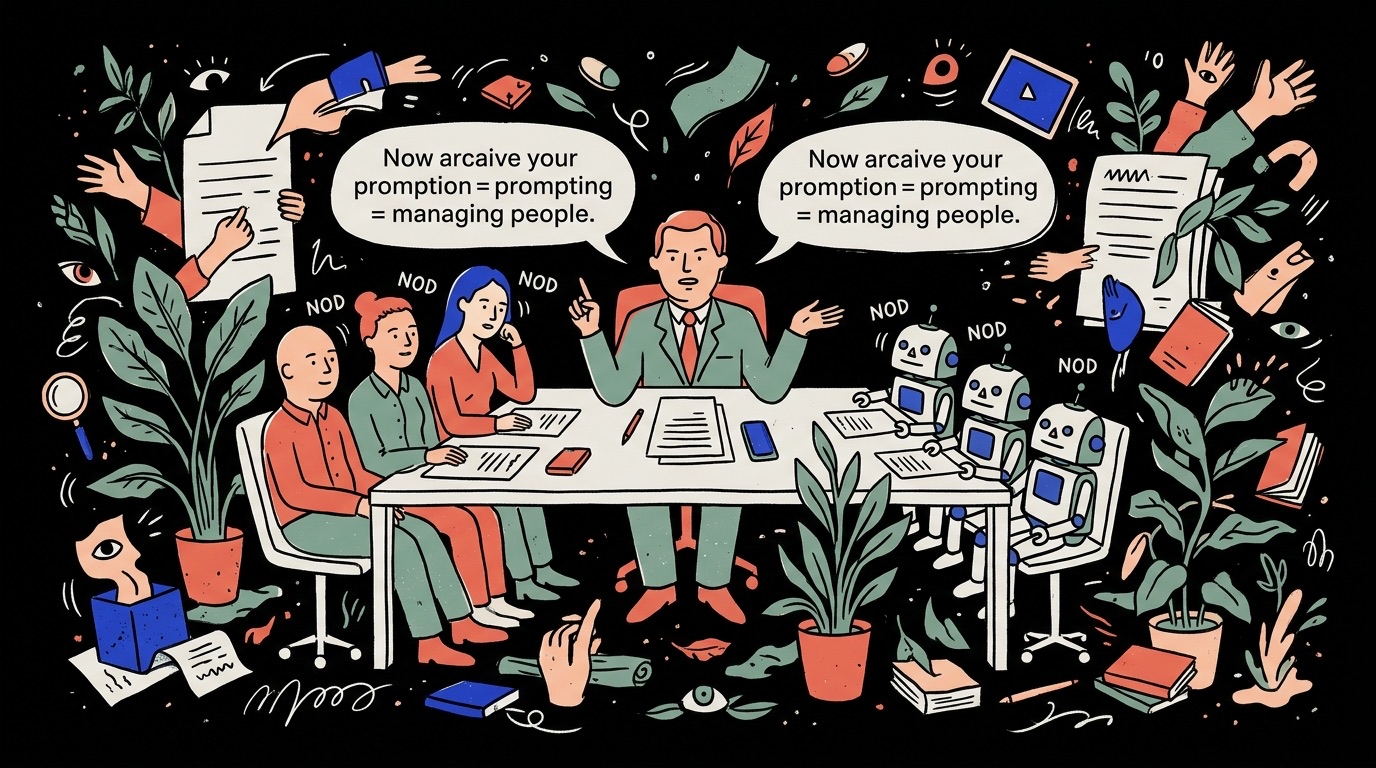

The Skill Nobody Recognizes
I've trained enough teams to know this: the best AI users aren't the most technical people in the room. They're the best managers.
Not managers by title — managers by skill. The person who knows how to give clear direction, set expectations, provide context, evaluate output, and give actionable feedback. That person will outperform the engineer who understands transformers but can't articulate what they actually want.
This shouldn't be surprising, but it is. The entire AI industry has positioned prompting as a technical skill — something you learn from engineers and practice with code. That framing is wrong, and it's holding back adoption in every organization that buys into it.
Prompting is management. Direction-setting. Delegation. Quality control. Feedback loops. It's the same skill set applied to a different kind of direct report.
The Five Management Skills That Transfer
When I break down what effective AI users actually do, it maps perfectly to management fundamentals:
1. Give direction. A good manager doesn't say "make something good." They say "I need a competitive analysis of these three brands, focused on their pricing strategy, by Thursday, formatted as a comparison table with a recommendations section." That level of specificity is exactly what produces great AI output.
The people who get mediocre results from AI are the ones who give mediocre briefs. "Write me a blog post about AI" produces garbage. "Write a 1,000-word blog post arguing that AI training should focus on workflow automation rather than tool tutorials, written for creative directors at mid-size agencies, in a direct and opinionated voice" produces something useful. Same principle as managing a junior strategist.
2. Provide context. A good manager doesn't throw tasks at people without background. They share the brand guidelines, the client history, the strategic context, the previous work. AI works the same way. The more context you provide — through system prompts, project files, examples — the better the output.
Research from the World Management Survey suggests that a significant chunk of America's productivity advantage over other developed economies comes from management quality. Not technology. Not capital. Management. The way people give direction, provide context, and coordinate work. AI just gives us a new surface to apply those skills.
3. Evaluate output. A manager who accepts every deliverable at face value isn't managing — they're a rubber stamp. The same applies to AI. You need to evaluate critically: Is this accurate? Does it meet the brief? Would I send this to a client? Where might the reasoning be flawed?
This is where most AI users fail. They treat the output as authoritative because it sounds confident. Good managers know that confident doesn't mean correct — in people or in AI.
4. Give specific feedback. "This isn't right" is useless feedback for a human or an AI. "The introduction is too long, the tone is too academic for our audience, and the recommendation section needs concrete numbers instead of qualitative statements" — that's feedback someone (or something) can act on.
Every round of feedback to an AI is a management rep. You're practicing the same skill you need with your team, except the feedback loop is 30 seconds instead of a day.
5. Know when to delegate and when to do it yourself. A good manager doesn't delegate everything. They know which tasks benefit from delegation and which require their personal touch. AI is identical. Some tasks — research synthesis, first drafts, data analysis — are perfect for AI delegation. Others — final creative judgment, client relationship decisions, strategic pivots — need a human at the wheel.
The best AI users I've trained have a clear mental model of what goes to AI and what stays human. They're not trying to automate everything. They're delegating strategically, the same way a good manager delegates to their team.
Why This Matters for Training
If prompting is management, then AI training belongs in a different department than most organizations think. It's not an IT initiative. It's not a technology experiment. It's a management development program.
The implication: the people who should be teaching AI skills aren't engineers. They're the people who understand how work gets done in organizations. People who understand workflows, quality standards, communication, and feedback loops.
This is exactly how we approach it at NotContent. Our training doesn't start with "here's how the technology works." It starts with "here's how your work works" — and then we show you how to direct AI within that context. The methodology is management methodology applied to a new tool.
The Business School Argument
Prompting should be taught in business schools. Not as a computer science elective — as a core management course. The skills it develops are the skills every manager needs: clarity of direction, quality of feedback, systematic delegation, critical evaluation.
Right now, the average business school graduate knows more about supply chain optimization than they do about directing an AI system that could automate half their future job. That gap will close, but the organizations that close it first will have a multi-year head start on the ones that wait for the curriculum to catch up.
You don't need to wait for business schools. You can start building these skills in your team now. Just stop treating AI as a technology problem and start treating it as what it actually is: the newest — and most responsive — member of your team.