
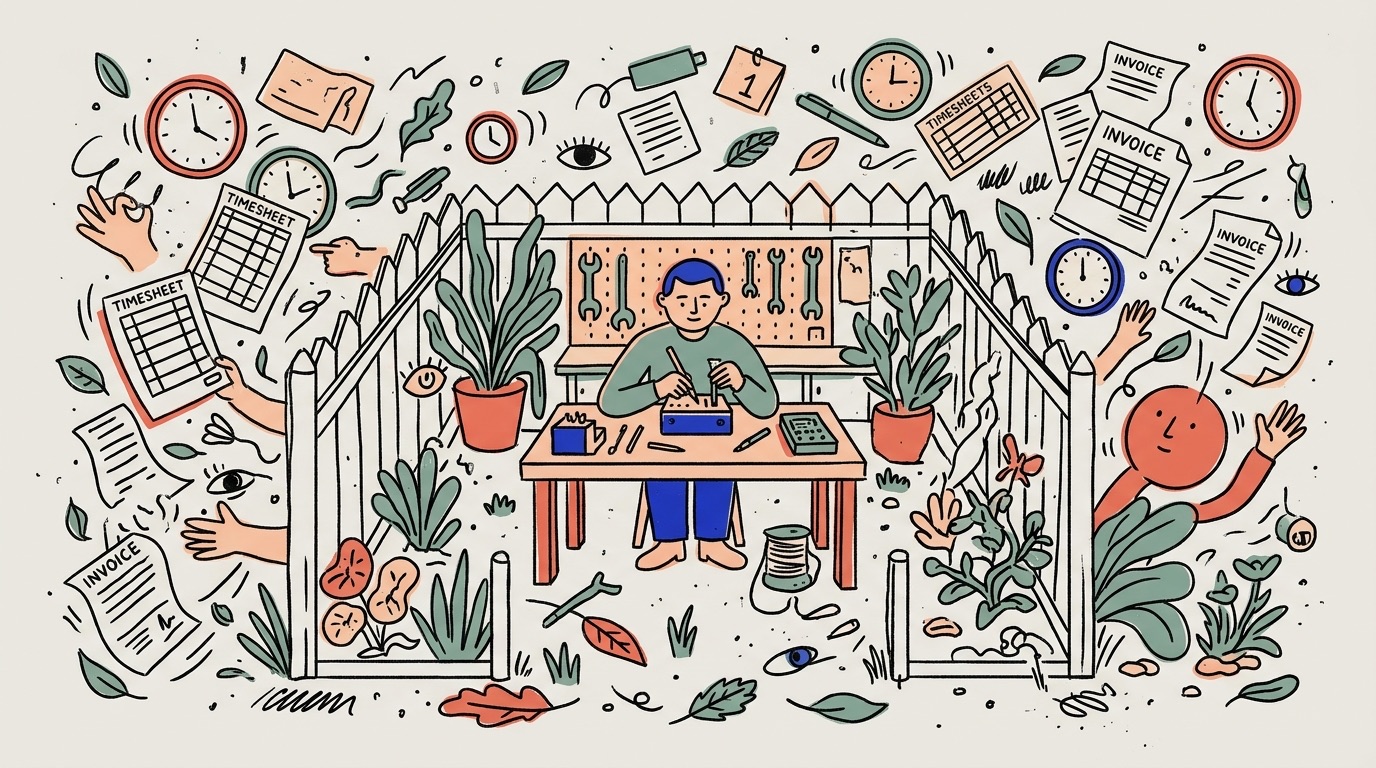

The Expectation That Quietly Keeps Teams Stuck
This is the conversation I have with agency leaders more than any other.
"We're investing in AI. We brought in tools. We sent people to a workshop. And somehow our team still isn't building anything."
Then, often in the same breath: "They've got to find the time to build workflows between client deliverables. We can't stop the billable work."
The second sentence is the answer to the first. And leadership hasn't yet connected the dots.
What's Actually Being Asked
When you tell your team to learn AI on top of their existing workload, you are asking for one of two things. Either they eat into the time they spend on client work — which is billable, which is the reason you exist commercially — or they eat into their personal time, which is unpaid.
Neither of those is sustainable. Neither one produces the kind of deep, persistent capability that shifts how an agency operates.
And both of them produce the same result, which is basic usage. Team members will learn just enough to send a tidier email. They won't build the system prompts, the custom GPTs, the automated workflows, the multi-step integrations that actually change what the agency can deliver.
The Spark AI 2026 report says this cleanly: "We see agencies expecting their workforce to learn how to use AI brilliantly on top of their billable hours. This keeps people trapped as basic users because they never get the deep, focused time required to build tools."
Basic users. That's the ceiling you're hitting. And leadership built it.
Why the Productivity Paradox Starts Here
Chapter one of that same Spark report documents what happens next. Teams do get faster — 89% of staff are saving time every week. Up to ten hours per person. But the recovered hours get reabsorbed into delivery, email, and meetings instead of reinvested into building capability.
It's the same pattern from two angles. If you don't protect the time, nothing upstream changes.
The original workload stays the same. The AI efficiency stays at the surface level. The advanced capability — the thing you actually paid the training for — never compounds, because there's never a dedicated moment for it to compound.
This is why agencies that trained their teams two years ago and saw a burst of productivity are now plateauing. The fix isn't more training. The fix is protected time to apply what people already learned.
The Fix Is Not Complicated
Carve out dedicated experimentation time. That's it. That's the whole move.
The agencies I've seen actually break through this do it in one of two ways. Either a recurring monthly hackathon afternoon — half a day, cleared calendars, everyone builds something real. Or a protected two-hour block each week on every team member's calendar, named, treated as non-negotiable, scheduled as seriously as a client meeting.
Name it. Put it in the calendar. Make attendance required.
When someone says "I've got client work," leadership has to be willing to say "the client work does not get to take this time." Because if leadership blinks on that once, twice, the ringfence collapses and you're back to the place where the capability never develops.
The Spark report surfaces one example worth studying. Canva dedicated a full week — an entire company-wide week — to structured AI exploration. Meetings cancelled. Output expectations suspended. Role-specific workshops running in parallel. Teams built working prototypes together, set their own goals, and presented what they'd made.
The outcomes that came out of that week, according to the Spark research: sales teams built custom AI assistants. Design teams cut production time in half. Product teams used synthetic data to test new features in ways that previously required significant resources.
A week. That's the scale at which dedicated time produces real operational change. If you can't give a week, give a day a month. If you can't give a day a month, give two hours a week. But give something.
Protected Time Is the Training Budget
This is the reframe most leaders haven't made yet.
When you price out AI training, you include the cost of the sessions, the tools, the licences, maybe a consultant. Then you assume the learning will absorb into normal working hours. That's the budget logic.
The real budget logic is different. The training session is the cheap part. The time to apply it — and to build on it — is the expensive part. And it's expensive whether you pay for it or not. Either you protect the time and get the capability, or you don't protect it and you wasted the training investment.
Any training program that isn't paired with protected build time is a sunk cost waiting to be realised. You can check that on your own P&L. Look at what you've invested in AI training across the last eighteen months. Now ask your team what they actually built with it. The delta is what ringfenced time would have produced.
The Psychological Piece
There's one more thing worth saying about this. People will only use the protected time if they believe it's real.
If leadership tells the team "Fridays are AI build time," and then on the third Friday there's a client escalation and the build time gets overrun, the message the team takes away is: the time isn't real. Next Friday people will quietly take a client call during the block. A week later, nobody will be using it at all.
Protect the time like you mean it. If a genuine client emergency eats into one session, explicitly reschedule the block — don't let it disappear. The signal to the team has to be that build time is as serious as any billable commitment.
This is where most agencies fail. Not in the intent. In the follow-through.
Decide. Ringfence. Defend.
You already made the decision to invest in AI. You bought the tools. You paid for the training. You brought in speakers or consultants or whoever.
The next decision is the one that matters more than any of those. Decide to give the team the time to actually use what you paid for. Ringfence it. Defend it against the client work that will absolutely try to eat it.
If you don't do this, the AI strategy you think you have is a workshop and a set of logins. If you do do it, you're giving your team the single most important resource they need to turn that workshop into real capability.
Protected time is the training budget. Spend it.