
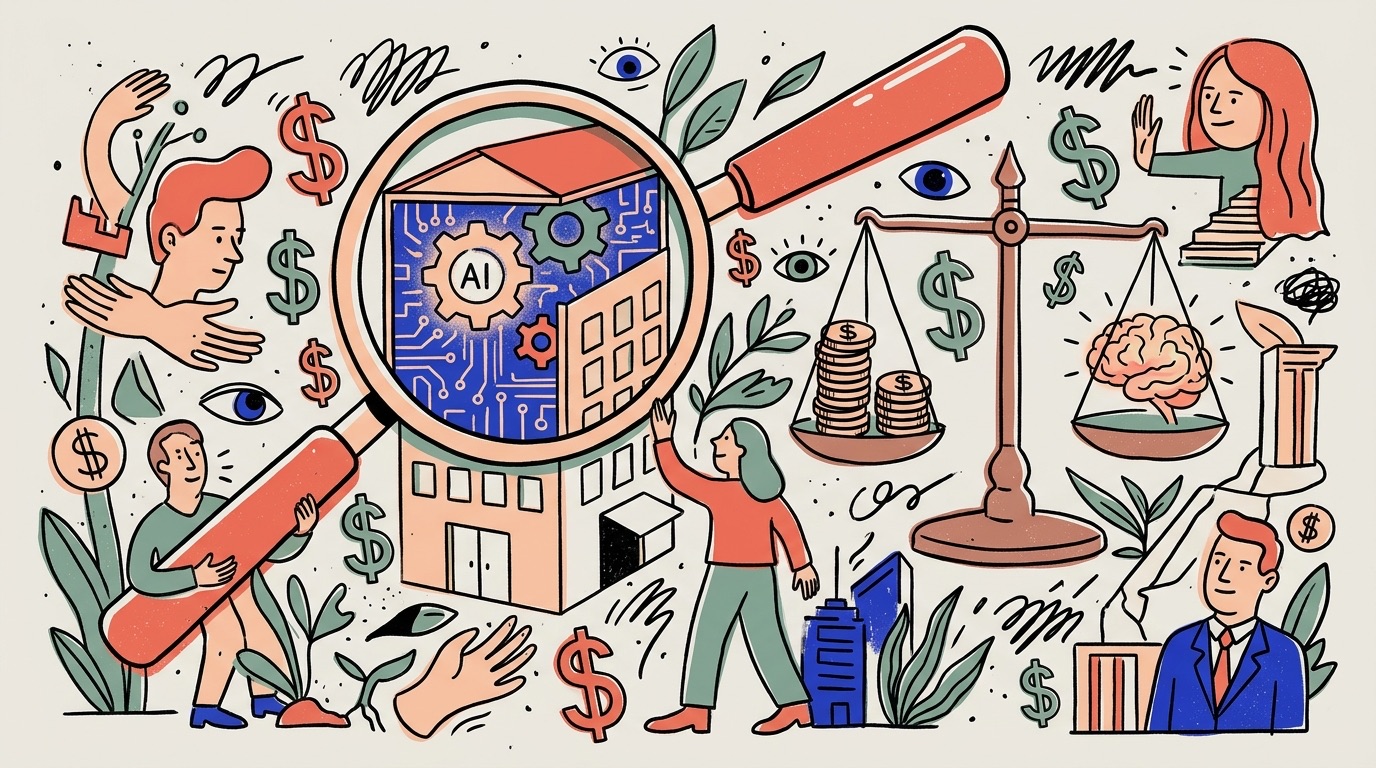

The Question Buyers Are Now Asking
Until recently, agency valuation was pretty well-understood. Revenue quality. Client concentration. Team tenure. IP. Recurring work. EBITDA.
There's a new line on the checklist now.
Spark AI's 2026 report is specific about this. Cactus's 2025 M&A report included operational AI readiness as a valuation metric. BDO has stated publicly that AI maturity is becoming a market differentiator. Buyers are walking into due diligence with a new set of questions — and the answers that used to be fine are not anymore.
"Show us your AI capability" is no longer a nice-to-have question. It's a valuation question.
What "Fine" Used to Look Like
A year or two ago, the honest answer most agency leaders could give was: "We've got a few people experimenting. We use ChatGPT. We've looked at a couple of tools. We're figuring it out like everyone else."
That answer was fine. Everyone was in the same position. No buyer was going to ding your valuation for it.
That window has closed. The industry has moved, the data has moved, and the benchmarks have moved. What was "fine" six months ago is now "behind." And buyers know the difference.
The Spark report found 89% of agency staff are saving time with AI every week, 52% of activity is informal, and only 15% of staff operate at genuinely advanced AI capability. An agency that can describe where it sits on that spectrum looks very different to an agency that can't.
What Due Diligence Actually Looks at Now
Three things, based on what I'm hearing from buyers and growth partners in the room.
Systematised IP, not individual heroes. Buyers want to see documented workflows, written SOPs, custom GPTs and agents owned by the agency rather than by individual accounts. The question behind the question is simple: if we acquire this business and three people leave, does the AI capability remain?
If the answer is no, your multiple takes a hit. If the answer is yes, you've just demonstrated the kind of operational maturity buyers are actively paying a premium for.
Documented governance. The same principle applies here. Buyers want to see an AI policy. Client contract language that reflects AI usage. Approved tool lists. Data handling standards. Evidence that leadership has actually thought about risk.
Spark's data showed 75% of agencies still have client contracts that don't mention AI. That's a due diligence red flag. It's also one of the easiest things in the world to fix before you go to market.
Commercial maturity. How does AI show up in your pricing? In your case studies? In your client conversations? Buyers are looking for evidence that you've moved past "we use ChatGPT to save time" and into "here's the category of work we can now charge more for because we can deliver it differently." That's the test for whether AI is a competitive advantage or a line-item productivity tool.
The Individual-Versus-Institutional Problem
This is the one that catches most agency leaders off guard.
Your best AI capability probably lives with two or three people. The ones who built the custom workflows. The ones who figured out the integrations. The ones who know which prompts produce which outputs on which accounts.
That's capability. Right now, in most agencies, it's also a personal asset, not a business asset. If those individuals leave, they take the capability with them.
In a due diligence conversation, that's a structural weakness. Buyers will see it immediately. They're specifically looking for it — because they've bought agencies before where the AI story walked out the door six months after closing, and the new owners were left holding a valuation that no longer matched reality.
The fix isn't complicated. It's documentation, ownership transfer to the business, and a way of working that makes the capability repeatable by anyone who joins. It's also the kind of project that takes nine months to do well, which is exactly why leaders who wait until they're approached by a buyer are already behind.
What to Do Now
If selling, fundraising, or bringing on a growth partner is a plausible next three-year scenario — and for most agencies it is — start the work now.
Audit where the capability actually lives. Which workflows are in people's heads versus documented. Which prompts are saved to personal accounts versus shared workspaces. Which custom tools are built on personal API keys. Any item that can't survive a resignation is a valuation risk.
Transfer ownership to the business. Move subscriptions to team plans. Move custom GPTs into approved shared workspaces. Document the workflows. Record the reasoning. Make what exists in someone's head exist in a place the business owns.
Commercialise the story. If you've achieved real results — client savings, time-to-market gains, output quality shifts — make sure they're written up as case studies, with real client quotes where you can get them. Due diligence is story-driven. Data without narrative is just a spreadsheet.
Publish a responsible AI position. One page on your website. It signals operational maturity to clients and to buyers at the same time, and it costs basically nothing to produce.
The Cost of Waiting
The longer you wait, the more expensive the fix gets.
An agency that starts systematising its AI capability today will have 12 to 18 months of documented progress by the time most buyers get serious. An agency that starts when the approach arrives will be trying to build three years of operational maturity in three months.
The market is not giving you credit for being in the middle of the pack anymore. Spark's data makes the split clear. Acquirers and investors are using AI maturity as a differentiator now. The agencies that are ahead will get paid for it. The ones that aren't, won't.
Don't wait for the approach. Build now.