
The Paradox
I keep hearing the same thing from creative directors and team leads: "We adopted AI. Everyone's faster. And somehow everyone's more burned out than before."
This isn't a contradiction. It's the most predictable outcome of AI adoption done without intention. And it's happening everywhere.
The numbers tell the story. Staff at creative agencies fell 14% in a single year — the largest drop since 2004. Advertised jobs declined 41%. Employees under 25 dropped by nearly 20%. Almost a quarter of agencies expect to cut more jobs due to AI this year — triple the number from last year.
Meanwhile, 90% of staff report recovering 1-10 hours per week through AI. So where did those hours go?
They went into more work. Not better work. More.
The Reabsorption Trap
Here's the pattern. A designer figures out how to use AI to cut their production time in half. Great. Their reward? Twice as many projects. A strategist automates their research workflow and saves 8 hours a week. Those 8 hours don't become thinking time or professional development or an afternoon off. They become 8 more hours of deliverables.
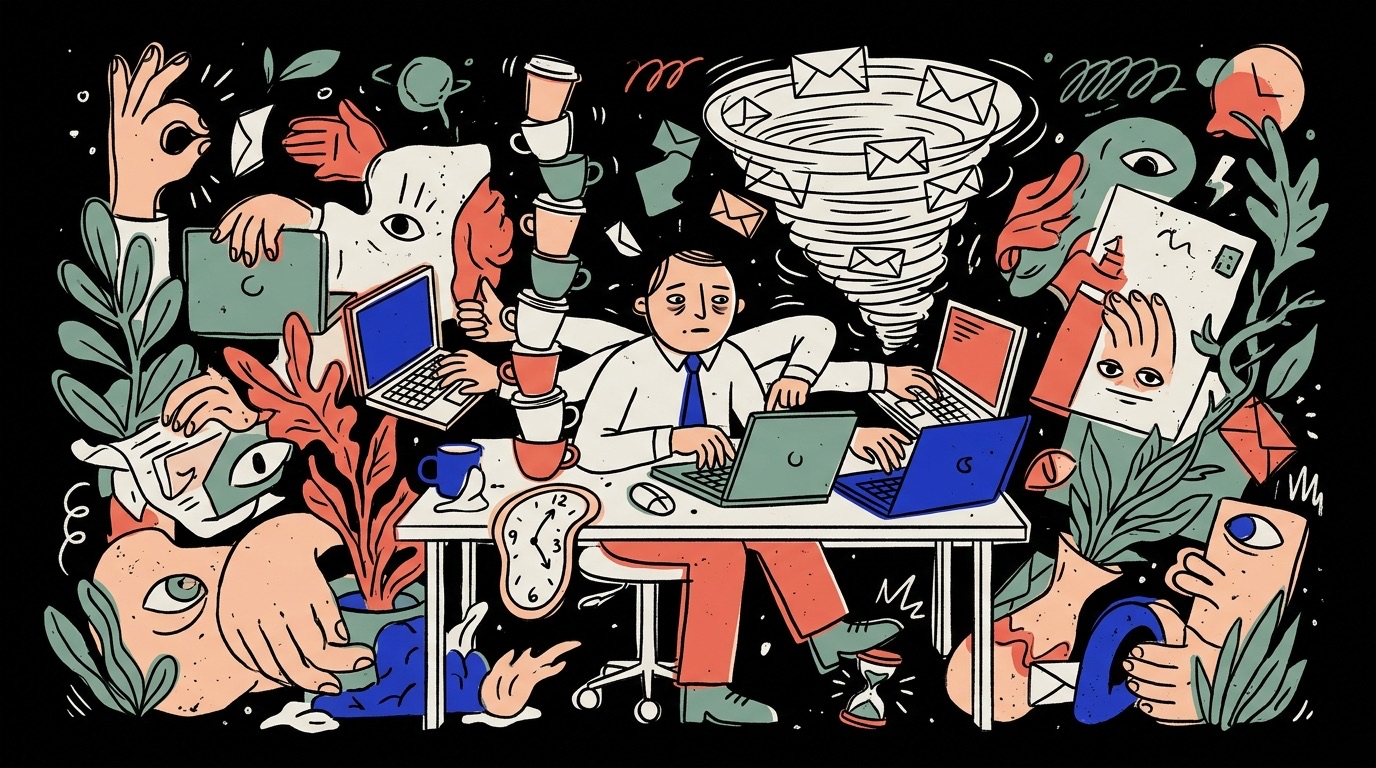
I call this the reabsorption trap. Every hour AI saves gets reabsorbed into volume. The team is producing more, billing more, and running harder — but nobody feels the benefit. Productivity goes up on the spreadsheet while morale goes down in the room.
This isn't new. It's what happened with email, with smartphones, with every productivity tool that was supposed to "free up time." The tools worked. The time management didn't. AI is just the latest — and most powerful — example.
Leadership Sets the Ceiling
The reabsorption trap is a leadership problem, not a technology problem. AI does exactly what it's supposed to do: it makes tasks faster. What happens with the saved time is a decision — and right now, most leaders are making that decision by default rather than by design.
I've trained teams where leadership explicitly said: "The time AI saves goes into quality, not volume." Those teams are thriving. They're producing the same output in less time, with higher quality, and their people aren't fried.
I've trained other teams where leadership said nothing — and the implicit message was "faster means more." Those teams are producing impressive numbers and losing their best people.
The difference isn't the AI. It's the intent.
What Smart Teams Do With Saved Time
The best teams I've worked with treat AI-saved time as an investment, not a windfall. Here's how they allocate it:
30% to quality. The work that used to take 40 hours still gets 40 hours — but now 12 of those hours are AI-assisted production and 28 are human refinement, ideation, and craft. The output is dramatically better because humans spend their time on the parts that require judgment, taste, and originality.
30% to capability. Saved time becomes learning time. Teams experiment with new workflows, build new automations, develop new skills. This is how AI adoption compounds — the first automation saves time, and that time funds the second automation, which funds the third.
40% to sustainability. Some of the saved time actually stays saved. Teams work reasonable hours. People have headspace. Creativity requires slack — the mental kind, not the app. Teams running flat out produce mediocre work regardless of how much AI they use.
The Headcount Question
Here's the uncomfortable part. Companies are using AI to do the same work with fewer people. That's happening whether leaders talk about it or not.
The honest version of this is: AI changes the math on team size. A 10-person team with strong AI workflows can produce what a 15-person team produced before. You can use that fact to fire 5 people, or you can use it to do 50% more with the same team, or you can use it to do the same work in fewer hours and invest the difference in your people.
The organizations that will win the next five years are the ones that choose option two or three. Because the organizations that choose option one are going to discover something: the AI doesn't have taste. The AI doesn't understand your client's brand. The AI doesn't navigate internal politics or build relationships or know when a brief is wrong. You still need people for that. Fewer, maybe. But better-supported, better-trained, and not running on empty.
The Burnout Audit
If your team adopted AI and nothing feels different except the pace, try this exercise:
List every workflow your team automated in the last 6 months. Next to each one, write down what happened with the time that was saved. If the answer is always "more deliverables" — you've found the problem.
Then make a decision. What percentage of AI-saved time goes to quality, capability, and sustainability? Write it down. Tell your team. Hold yourself to it.
AI is the most powerful productivity tool creative teams have ever had. Whether it makes your team's lives better or worse is entirely up to how you lead.