
What This Isn't
This isn't Midjourney training. Tools change every quarter. The team that learns Midjourney v6 in January is relearning v7 by March. If your training is built around a specific tool, it has an expiration date. And that date is closer than you think.
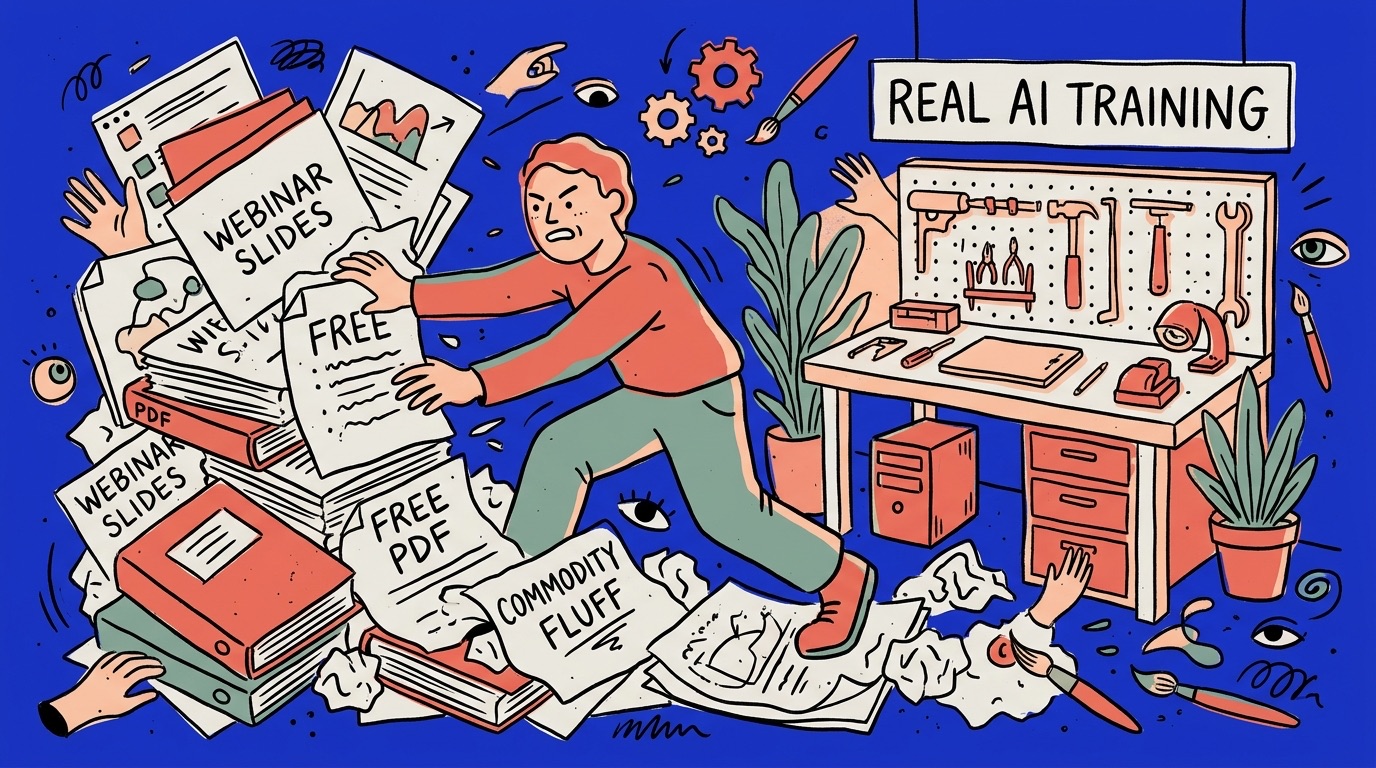
This isn't a ChatGPT webinar with a PDF. I've seen these. Two hours of screen sharing, a Q&A where nobody asks anything real, and a 14-page "resource guide" that lives in someone's Downloads folder until they buy a new laptop. That's not training. That's a lunch-and-learn with lower stakes.
This isn't "AI for beginners." Your team already uses AI. They Google things. They've tried ChatGPT. They've probably generated some images for a mood board. They don't need an introduction. They need a system.
This isn't a prompt library. "Here are 50 prompts for creative professionals!" Great. Now what? Prompt libraries are recipes without a kitchen. They give you what to say without teaching you how to think. The moment you hit a task that's not in the library, you're back to guessing.
This isn't your mom's GPT workshop. No offense to your mom. But the "AI demystified" sessions that corporate training departments love to book? They're designed to make everyone comfortable. Comfortable doesn't produce results. Uncomfortable does — the productive kind, where your team discovers they can do things they genuinely couldn't do yesterday.
What This Actually Is
This is a system for making your entire creative team dangerous with AI — in weeks, not quarters.
Dangerous meaning: they produce more, faster, at higher quality, with less wasted effort. Dangerous meaning: they stop using AI as a novelty and start using it as infrastructure. Dangerous meaning: your competitors look at your output volume and wonder how you're staffing it.
The system has three layers.
Layer one: the platform. Your team learns to configure Claude — system prompts, projects, styles, memory. This is the foundation that turns a chatbot into a business tool. Most teams never get here. They stay in the chat window, typing one-off prompts, getting one-off answers. That's not adoption. That's a search engine with better grammar.
Layer two: the methodology. Diverge, Converge, Build. First you explore what's possible — broad, experimental, no constraints. Then you refine what works — build repeatable workflows, create templates, establish quality standards. Then you deploy — connect to your tools, automate the repetitive parts, build the infrastructure that scales.
This isn't unique to AI. It's how good creative operations have always worked. We just applied it to the most powerful creative tool that's ever existed.
Layer three: the management skills. Your team now manages AI agents alongside human collaborators. That requires a new set of skills — context switching, output evaluation, systematic delegation, feedback loops. Nobody teaches this. We do. Because the team that can effectively manage AI agents will outproduce the team that just "uses AI" by an order of magnitude.
The Methodology Matters More Than the Tools
I founded one of the first AI-assisted creative agencies. We produced real campaigns for Adidas, Google, Tommy Hilfiger — before most agencies knew what a diffusion model was. I watched the tools change four times in 18 months. Stable Diffusion to Midjourney to DALL-E 3 to Flux. Different interfaces. Different strengths. Different workflows.
The methodology didn't change once.
Diverge, Converge, Build works regardless of which model you're using. It works because it's built on how creative teams actually produce — not on the specifics of any one tool. When Midjourney ships v8, our teams don't retrain. They apply the same methodology to the new capabilities and keep shipping.
This is the difference between training that expires and training that compounds. One teaches you a tool. The other teaches you a way of working that makes every tool more powerful.
Who This Is For
This is for the creative director who knows AI matters but hasn't figured out how to integrate it into production workflows without breaking everything.
This is for the head of content who's tired of seeing AI demos that look amazing on Twitter and fall apart in a real brief.
This is for the brand manager who needs to produce 3x the content this quarter and just lost two people on the team.
This is for the agency owner who watched a competitor produce a campaign in two weeks that would have taken their team six.
This is for teams that are already good at what they do and want to become unreasonably productive at it.
What Happens After
The team that goes through this doesn't just "know AI." They have a configured platform, documented workflows, automated systems, and the management skills to keep evolving as the tools change.
Six months later, they're not asking "how do I use AI?" They're asking "what should we build next?" That's the shift. From consumer to builder. From passenger to driver.
Every team I've trained has made that shift. The timeline varies. The destination doesn't.
If this is the kind of training you've been looking for, you already know.